Kodi Wilson Felt Something Different. And She Didn’t Wait.
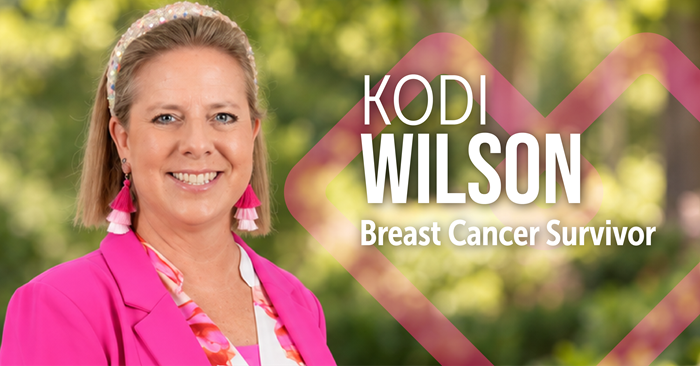
After a breast cancer diagnosis changed her life, one Baton Rouge woman learned that survivorship is about more than ringing the bell. It’s about showing up, speaking up and taking care of yourself.
Kodi Wilson knew breast cancer was a possibility. With a sister, cousin and three aunts who had been diagnosed, she had made breast health a priority. Then, about two and a half months after her most recent mammogram, she felt something different. It wasn’t like the cysts she had felt before, but a knot or bump that didn’t feel right.
So she got it checked, and that decision changed everything. Doctors found two areas in her right breast that needed to be biopsied, one was cancer and the other was a second type of cancer.
Because of her family history and the findings in her breast, she and her doctors decided on a double mastectomy. After surgery, pathology revealed two additional tumors, bringing the total to four. That means Kodi had both invasive breast cancer and ductal carcinoma in situ, an early form of non-invasive breast cancer. In the other breast without known tumors, they found pre-cancerous calcifications that signaled a strong likelihood cancer would develop there as well.
Kodi’s cancer was Stage 2A. Thankfully, it had not spread to her lymph nodes, although cancer cells were found in some of the small blood and lymph vessels within the breast tissue.
From the outside, the timing is striking: all of this happened before she would have even been due for her next mammogram.
A family history that changed the way she approached her health
Kodi is the sixth woman in her family to face breast cancer. Her sister was diagnosed at just 27, following a breast reduction. That history made regular monitoring part of Kodi’s routine, and she encourages other women with a strong family history to do the same.
She had also undergone a breast reduction less than 10 years earlier. Her breasts were cystic and contained dense tissue, which could make imaging more difficult. Over the past decade, she had also made major changes to her health -- she changed her diet, became more active, added holistic and functional health supplements and stopped ignoring signs from her body.
Still, even with all the appointments, lifestyle changes and attention to her health, cancer found her. That was difficult to accept. “I had hoped all these positive changes would prevent me from getting cancer,” she shares.
Kodi says she felt disappointed and angry. She wasn’t only thinking about herself, of course. She was thinking about her husband and daughter and everything her family had already endured. She had watched her family suffer the loss of a son. Her husband had nearly died from a widow-maker heart attack. The thought of putting them through another long, uncertain medical journey was overwhelming.
Treatment became the next mountain to climb. Her care team recommended four rounds of chemotherapy, often called the “red devil,” followed by 12 weeks of Taxol. In total, she spent five months receiving IV chemotherapy, along with additional treatments to manage its side effects.
At one point, Kodi’s list of side effects had grown to more than 50. “Cancer treatment isn’t easy for anyone,” she says. “It’s harder when you are a medical unicorn.”
She also chose cold capping in an effort to prevent permanent hair loss, a process that came with its own physical, financial and logistical challenges. Palliative care became an important part of her treatment, helping her manage side effects so she could continue working and functioning as much as possible.
For her, that support mattered.
Care that saw the person, not just the diagnosis
Throughout treatment, she says one of the most important things was having a medical team she could trust, a team that saw the person not just another patient.
That human connection helped her keep moving forward through some of the hardest days. So did her faith, her family and friends, and an online community where she could ask questions and get practical advice from people who had been through cancer themselves.
But perhaps the most meaningful support came in very ordinary moments. Meals. Cards. Help with her daughter. Someone staying with the family. A friend doing the dishes. Someone doing laundry, sweeping the floor or cleaning the bathroom. And financial support to help with the staggering out-of-pocket costs that can come with cancer treatment.
For someone who describes herself as extremely practical, those acts meant everything.
“Just show up and do something.”
One lesson she wants other people to understand is that supporting someone with cancer doesn’t always require finding the perfect words. Sometimes, it means doing the dishes.
“Let me know if there is anything I can do” can be well-intentioned, but someone going through cancer may not have the energy, clarity or emotional space to figure out what to ask for.
Instead, she says, just show up and do something.
And for the person going through cancer, she has another piece of advice: let people help. She suggests making a list of specific things people can do, from meals and errands to household chores and recovery supplies.
Cancer survivorship doesn’t end when the bell rings
Today, she is beginning the next chapter. But survivorship doesn’t look quite like the commercials and movies suggest.
There was no neat ending when IV chemotherapy finished. The side effects are still wearing off. She is working to rebuild her strength and stamina. She continues to deal with joint pain and brain fog, and she has new medications, including pill-form chemotherapy, that she expects to take for at least five years. There are also long-term health considerations and additional surgeries ahead.
And then there is the mental side of survivorship: learning how to live with the fear that every new ache or symptom could mean the cancer has returned.
She is learning to slow down, rest when her body tells her to and accept that recovery takes time.
Stronger than she knew
People have always told her she is strong, and during cancer treatment, Kodi says she started to believe them.
Her body may feel older than it did before cancer. Her strength and stamina have taken a hit. Some days are still difficult. But mentally, she says, she is determined to fight.
Her competitive nature has become part of that fight. “Cancer will not win,” she says. “I am going to win.” And she doesn’t want to simply survive. She wants to thrive with her family beyond this season of her life.
Listen to your body
If there is one thing she hopes other women remember, it is this: don’t ignore the feeling that something isn’t right. It may be nothing, but it may be something, and finding out is worth it.
Her own experience is a reminder that routine screenings matter, but so does knowing your body and speaking up when something changes.
Cancer changed her life.
But it also reinforced something she already knew: taking care of yourself is not selfish. The people you love are counting on you to do it.